Puppy Biting: Why It Hurts So Much and What to Do About It
Welcome to the puppy piranha phase.
You expected your puppy to chew on things.
You may not have expected to be one of the things.
Puppy biting can get ridiculous. Your hands are scratched, your pants have holes in them, walking across the room turns into an attack on your ankles, and trying to pet the puppy you couldn't wait to bring home somehow becomes another opportunity for them to put your entire forearm in their mouth.
And then somebody tells you, “Just redirect them to a toy.”
You've tried that. Your puppy dropped the toy and came right back for you.
So let's talk about what's actually happening and what to do when the usual advice isn't enough.
Puppy biting is very normal, but normal does not mean you have to spend the next four months being used as a chew toy. Puppies need to learn what they are allowed to put their teeth on, what makes play continue, what makes it stop, and how to come back down when they've gotten completely wound up.
First, biting and teething aren't exactly the same thing
They get lumped together constantly, but this distinction can save you a lot of frustration.
Teething creates a real need to chew. Your puppy's mouth is changing, their gums can be uncomfortable, and chewing on an appropriate toy can feel good. Puppies begin losing those incredibly sharp baby teeth as their adult teeth come in, and most have their adult teeth by around six months.
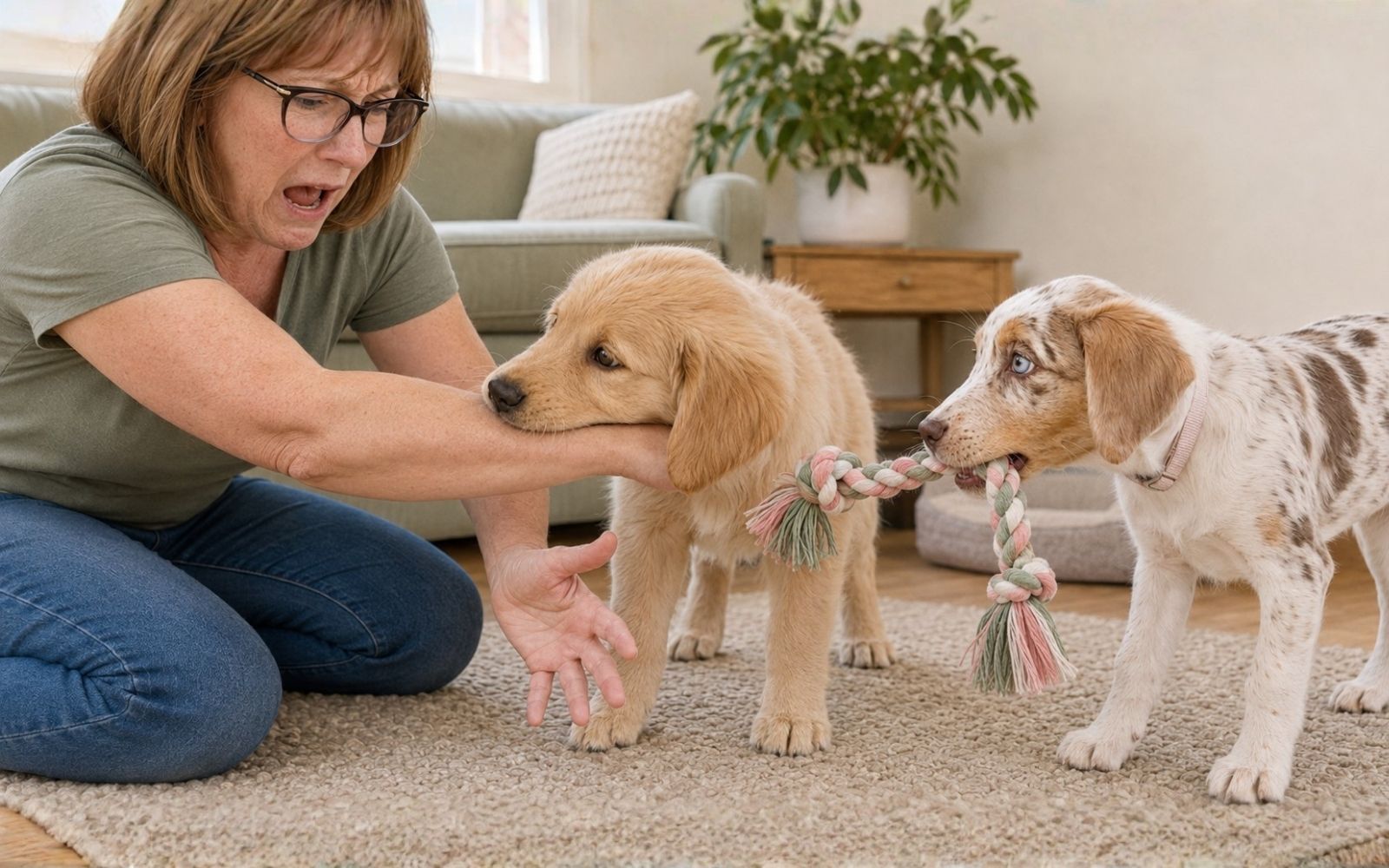
But when your puppy is chasing your feet, grabbing your sleeves, jumping up to bite your hands, or repeatedly coming back for another bite while you're trying to play with them, that's often puppy play, not simply sore gums.
That matters because a frozen chew may help a puppy whose gums hurt, but it isn't automatically going to teach an excited puppy that your ankles aren't part of the game.
You need both: appropriate things to chew and a plan for what happens when teeth land on people.
What to do when your puppy bites you
You don't need twelve techniques. You need a response you can actually remember while a puppy is attached to your pant leg.
1. Stop making your body part of the game
When teeth hit your skin or clothing, stop the interaction. Don't push the puppy away with your hands, wave your fingers in their face, wrestle them off you, or keep trying to pet them while telling them no.
All of that can still feel like play to an excited puppy.
Make yourself boring for a few seconds. Stand up, move your hands away, or step out of reach. If your puppy immediately comes back and starts biting again, end the interaction and briefly move away.
The lesson is simple: biting people makes the fun stop.
2. Give the mouth somewhere better to go
Keep appropriate toys close enough that you can actually reach one when you need it. A longer tug toy can be especially useful for puppies who want interactive play because it gives them something to grab without putting your hands right beside their teeth.
The timing matters, though.
If you know your puppy usually attacks your feet when you walk through the kitchen at 6 p.m., don't wait until they're already hanging from your ankle. Grab the toy before you start walking and give them a better game from the beginning.
Redirecting works much better when you're helping the puppy make a good choice than when you're trying to negotiate with a puppy who is already fully wound up and having the time of their life.
3. If the biting suddenly gets crazier, look at the whole puppy
This is the step that gets missed all the time.
If your puppy was manageable earlier and has now entered a state where no toy works, they won't stop grabbing you, they're racing around, and every attempt to calm things down somehow makes them worse, you may not have a biting problem at that moment.
You may have an exhausted puppy.
Overtired puppies don't always look sleepy. They can look completely unhinged. Biting and mouthing often get worse when puppies are overtired or overstimulated, and quiet time or a nap can be more useful than adding another round of play.
Take them out to potty, lower the activity level, and give them an opportunity to settle somewhere safe.
If they fall asleep almost immediately, there's your answer.
4. Pay attention to what happens right before the biting
This is where you can start getting ahead of it.
Maybe your puppy bites when you sit on the floor. Maybe they go for your ankles when you walk. Maybe petting turns into biting after about thirty seconds. Maybe the evening is awful. Maybe they lose their mind when the kids start running.
Those patterns are useful.
Instead of spending the entire day correcting biting after it happens, change the setup before the predictable biting starts. Have a toy ready. Shorten the petting session. Separate the puppy from running children. Start quiet time earlier in the evening.
The more often your puppy gets to rehearse biting people, the more practice they're getting at something you don't want them doing.
5. Be boringly consistent
This may be the least exciting advice on this page, but it's one of the most important.
If biting means play stops on Monday, but on Tuesday someone wrestles with the puppy using their hands, and on Wednesday the kids let the puppy chase their feet because it's funny, the puppy isn't failing to learn.
The rules keep changing.
Everyone doesn't have to interact with your puppy exactly the same way, but the basic rule should stay consistent: people aren't chew toys.
What about saying “OW!” when your puppy bites?
This works beautifully for some puppies.
For others, you just became a squeaky toy.
Puppies naturally learn about bite pressure during play with littermates, and a yelp can interrupt some puppies. But vocal reactions can also make an already excited puppy even more excited.
Try it if you want. If your puppy stops and backs off, great.
If their eyes light up and they come back at you twice as hard, you have your answer. Stop doing it and use a quieter end-of-play response instead.
There isn't a prize for sticking with a technique that clearly makes your puppy worse.
Why “redirect to a toy” sometimes feels completely useless
Because sometimes it is being asked to do too much.
A toy can give your puppy an appropriate thing to bite. It cannot fix every reason your puppy is biting.
If your puppy is overtired, they may need sleep.
If they're overstimulated, they may need less activity.
If you've been roughhousing with your hands, they may genuinely think your hands are part of the game.
If your puppy needs more appropriate play and enrichment, they may need an outlet.
And if the puppy has been chasing your pant legs successfully for the last three weeks, you're also dealing with a behavior they've had a lot of fun practicing.
So keep redirecting when it makes sense. Just don't keep waving toys at a puppy who is telling you the real problem is somewhere else.
Yes, those puppy teeth really do hurt
Your puppy has 28 baby teeth, and they are ridiculously sharp. Those teeth eventually give way to as many as 42 adult teeth.
Which seems backward, because the 28-tooth version is somehow the one capable of turning your forearms into modern art.
Small punctures and scratches can happen during normal puppy biting. That doesn't mean your puppy is mean and it doesn't mean you're overreacting when it hurts.
Your puppy is learning how much pressure is too much, and part of raising them is helping them learn that human skin is considerably less forgiving than another puppy wrestling back.
Give teething something useful to work on
Even though teething doesn't explain all puppy biting, your puppy still needs appropriate things to chew.
Try different textures rather than buying six versions of the same toy. Some puppies like rubber. Some prefer something softer. Food-stuffed toys and puppy-safe products designed to be chilled or frozen can give sore gums something appropriate to work on.
Whatever you use should be appropriate for your puppy's size and chewing style, and chewing should be supervised because no chew toy is completely indestructible.
The goal isn't to stop your puppy from wanting to chew.
It's to make sure they don't have to invent their own chew-toy collection from your shoes, furniture, and body parts.
Things that usually make puppy biting worse
Getting angry at a biting puppy is understandable. It also doesn't teach them much.
Holding the muzzle shut, smacking the nose, pinning the puppy down, physically intimidating them, or escalating into a wrestling match can create fear, increase arousal, or turn the whole interaction into even rougher play.
You don't have to be passive about biting.
End the game. Remove your attention. Prevent the puppy from immediately launching another attack. Give them something appropriate to do. Help an exhausted puppy settle.
There is a big difference between setting a boundary and frightening a puppy into stopping.
When puppy biting may be more than normal puppy biting
Most puppy mouthing and play biting is exactly that: puppy behavior.
But not every bite should automatically be dismissed as “just a puppy being a puppy.”
Pay closer attention if biting is regularly connected to fear, guarding food or objects, handling certain parts of the body, being approached while resting, or if you're seeing stiff body language, growling, snarling, snapping, or escalating defensive behavior in situations that don't look like ordinary rowdy play.
If fear, guarding, pain, or defensive behavior appears to be involved, talk with your veterinarian or a qualified behavior professional rather than trying increasingly forceful corrections at home.
Your puppy doesn't need another clever biting trick
They need the same understandable rules over and over again.
Give them good things to bite. Stop the game when they bite you. Watch for the moments when biting starts getting worse instead of waiting until you're already frustrated. Make sure an exhausted puppy actually gets some sleep, and change the setup when you can see trouble coming.
And remember that you're not trying to remove your puppy's desire to use their mouth. Dogs chew, carry things, tug, play, and explore with their mouths.
You're teaching this particular puppy how that works in your house, with your family, and with your skin.
That takes some repetition.
But it makes a lot more sense once you stop treating every bite like it's the exact same problem.
Raising My Puppy provides general puppy training and care guidance, not veterinary, behavioral or medical diagnosis or treatment. Contact your veterinarian, a qualified behavior professional, or your doctor for any concerns.
All guides · Planners · Home · Pricing