FREE 3-DAY STARTER PLAN
The 3-Day Puppy Crate Training Plan
Three days. Three stages. One puppy learning that the crate is a perfectly good place to relax while you get on with your day.
This plan begins with treats tossed into an open crate. By Day 3, many puppies can relax inside for 20 to 30 minutes while you shower, work in another room or briefly leave home.
The secret is repetition.
Every day, your puppy will practice familiar skills, add something new and finish with another easy win. By the end of the three days, the crate will no longer be a strange box that suddenly closes. It will be part of the daily routine.
Let’s get started.
Save this page now. Tomorrow’s games build on today’s wins.
BEFORE YOU BEGIN
Set Up the Crate
Place the crate where your puppy can be near the household without sitting in the middle of every bit of activity.
The crate should be large enough for your puppy to stand, turn around and lie down comfortably.
Add suitable bedding if your puppy does not chew or shred it. Keep collars and harnesses off while your puppy is crated.
Have these ready:
- Small treats
- Kibble
- A safe chew
- A food-stuffed toy
- Your puppy’s regular meals
- Something for you to do while your puppy settles
Plan Four Practice Times
Aim for four practice blocks each day:
- Morning
- Midday
- Late afternoon
- Evening
Most active practice will take five to ten minutes. Some sessions will last longer because your puppy is eating, chewing or settling in the crate.
A puppy who has gone potty, moved their body and had a chance to use their brain will have an easier time settling.
THE EASY, EASY, STRETCH PATTERN
This is the pattern you will use throughout the plan:
- Repeat an easy step.
- Repeat another easy step.
- Try one slightly harder step.
- Return to something easy.
For example:
- Step away for 5 seconds.
- Step away for 5 seconds.
- Step away for 15 seconds.
- Step away for 5 seconds.
Every new challenge is surrounded by repetitions your puppy already understands.
If your puppy stays relaxed, takes treats and returns to their chew, continue.
If the new step gets a big reaction, make the next repetition shorter or easier. That is not going backward. That is how you keep the game moving.
DAY 1: MAKE THE CRATE THE BEST SEAT IN THE HOUSE
Today’s Destination
By tonight, your puppy may be:
- Running into the crate for a reward
- Eating or enjoying a chew inside
- Remaining inside when the door closes
- Relaxing behind the door for one or two minutes while you stay nearby
Today includes dozens of easy entries. By the end of the day, walking into the crate should feel familiar.
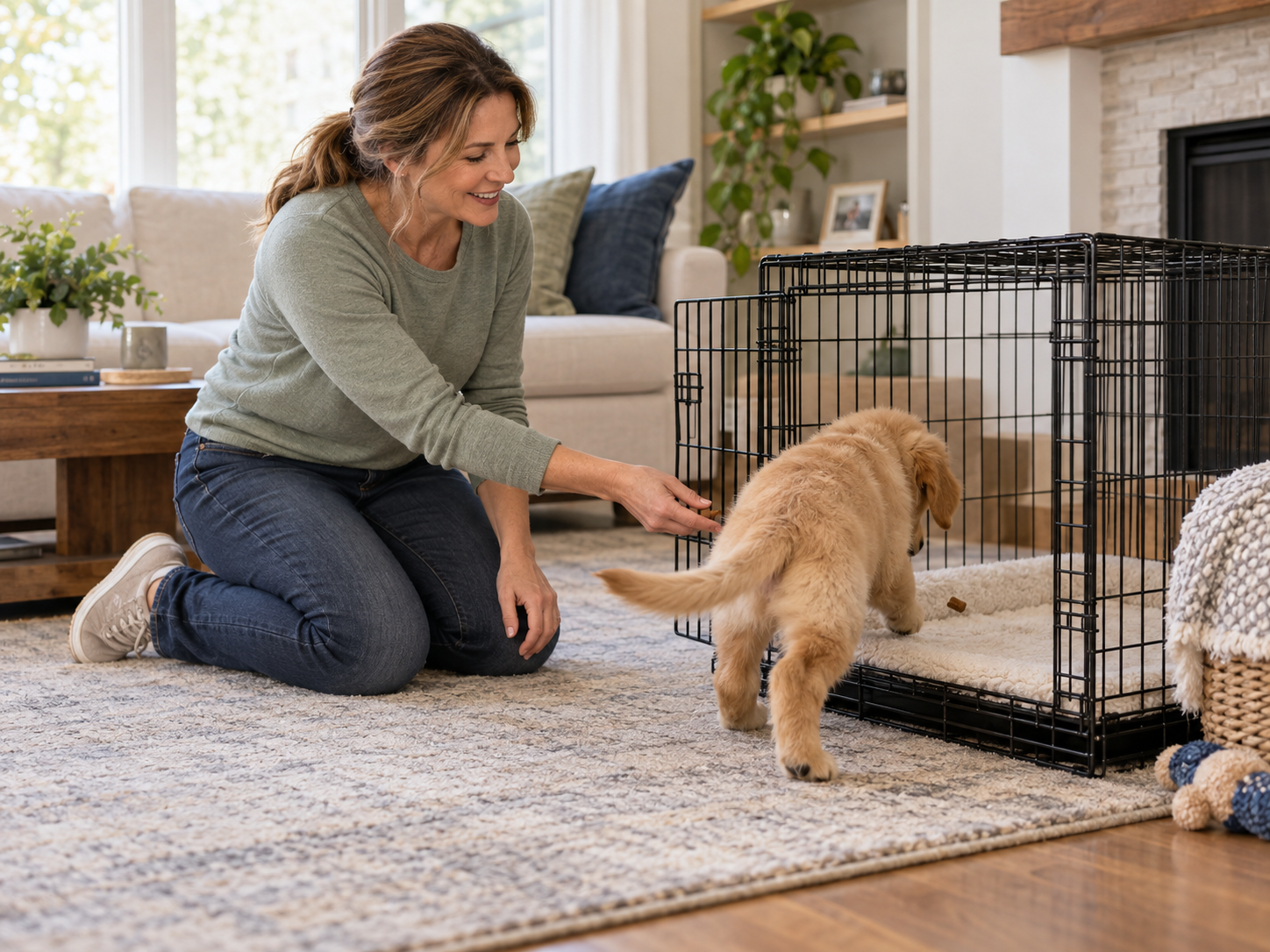
MORNING: THE CRATE JACKPOT
Start with 10 quick repetitions.
- Toss a treat into the crate.
- Let your puppy run inside and eat it.
- Let them walk back out.
- Toss another treat inside.
Keep the door open and the energy upbeat.
After several repetitions, say “Crate!” just before tossing the treat.
Pause for one second before the next toss. Your puppy may begin heading inside before the treat lands.
When that happens, celebrate by dropping three or four treats between their paws.
That is the Crate Jackpot.
Morning Goal
Your puppy begins connecting the word “crate” with running inside to collect something good.
MIDDAY: IN, OUT AND BACK AGAIN
Begin with five rounds of the Crate Jackpot.
Now add a little more time inside:
- Say “Crate.”
- Let your puppy enter.
- Give three treats, one at a time.
- Say a release word such as “Okay!”
- Let your puppy walk out.
- Invite them back in.
Complete five to ten rounds.
Vary the number of treats. Sometimes give one. Sometimes give three. Occasionally deliver another jackpot.
Your puppy is learning two useful cues:
- “Crate” means go inside.
- “Okay” means come back out.
Midday Goal
Your puppy waits inside for the release word instead of immediately turning around and leaving.
AFTERNOON: THE CRATE CAFÉ
Serve a meal, safe chew or food-stuffed toy inside the crate.
Let your puppy enjoy it for five to ten minutes with the door open.
Sit nearby without entertaining them. Read something, check your phone or fold laundry.
Every minute or two, walk past and casually drop an extra treat inside.
If your puppy walks out, leave the activity in the crate. The best place to continue enjoying it is inside.
Afternoon Goal
Your puppy chooses to remain in the crate because something worth staying for is happening there.
EVENING: CLOSE, TREAT, OPEN
Begin with five easy crate entries.
Now add the door:
- Cue your puppy into the crate.
- Close the door.
- Give a treat through the crate.
- Open the door.
- Repeat.
Keep the first rounds quick and cheerful.
Then begin adding time:
- Close and immediately open
- 5 seconds
- 10 seconds
- 20 seconds
- 30 seconds
- 1 minute
- 2 minutes
Use the Easy, Easy, Stretch Pattern instead of climbing straight up the list.
A practice sequence might look like this:
- 10 seconds
- 10 seconds
- 30 seconds
- 10 seconds
- 20 seconds
- 1 minute
- 20 seconds
- 2 minutes
Stay near the crate. Sit down, stand up and move naturally without leaving the room.
Open the door calmly. The door opening does not need to be the most exciting part of the game.
Evening Goal
Your puppy stays comfortable with the door closed for one or two minutes while you remain nearby.
THE DAY 1 WIN
Today your puppy practiced entering the crate dozens of times.
They learned the crate cue, practiced waiting for a release word, ate or enjoyed a chew inside and discovered that the door can close and open again.
Yesterday, the crate may have been unfamiliar.
Tonight, your puppy knows exactly where the treats are kept.
DAY 1 COMPLETE
DAY 2: ADD TIME, MOVEMENT AND DISTANCE
Today’s Destination
By tonight, your puppy may be:
- Entering as soon as they hear the crate cue
- Relaxing behind the closed door
- Watching you move around without needing to follow
- Handling short periods when you leave the room
- Spending 10 to 15 minutes in the crate while you do something nearby
Today begins with yesterday’s wins. Then you will add normal household movement and short absences.
MORNING: THE FIVE-MINUTE COMEBACK
Begin with a quick Day 1 review:
- Five happy crate entries
- Three close-treat-open repetitions
- One 30-second repetition
- One one-minute repetition
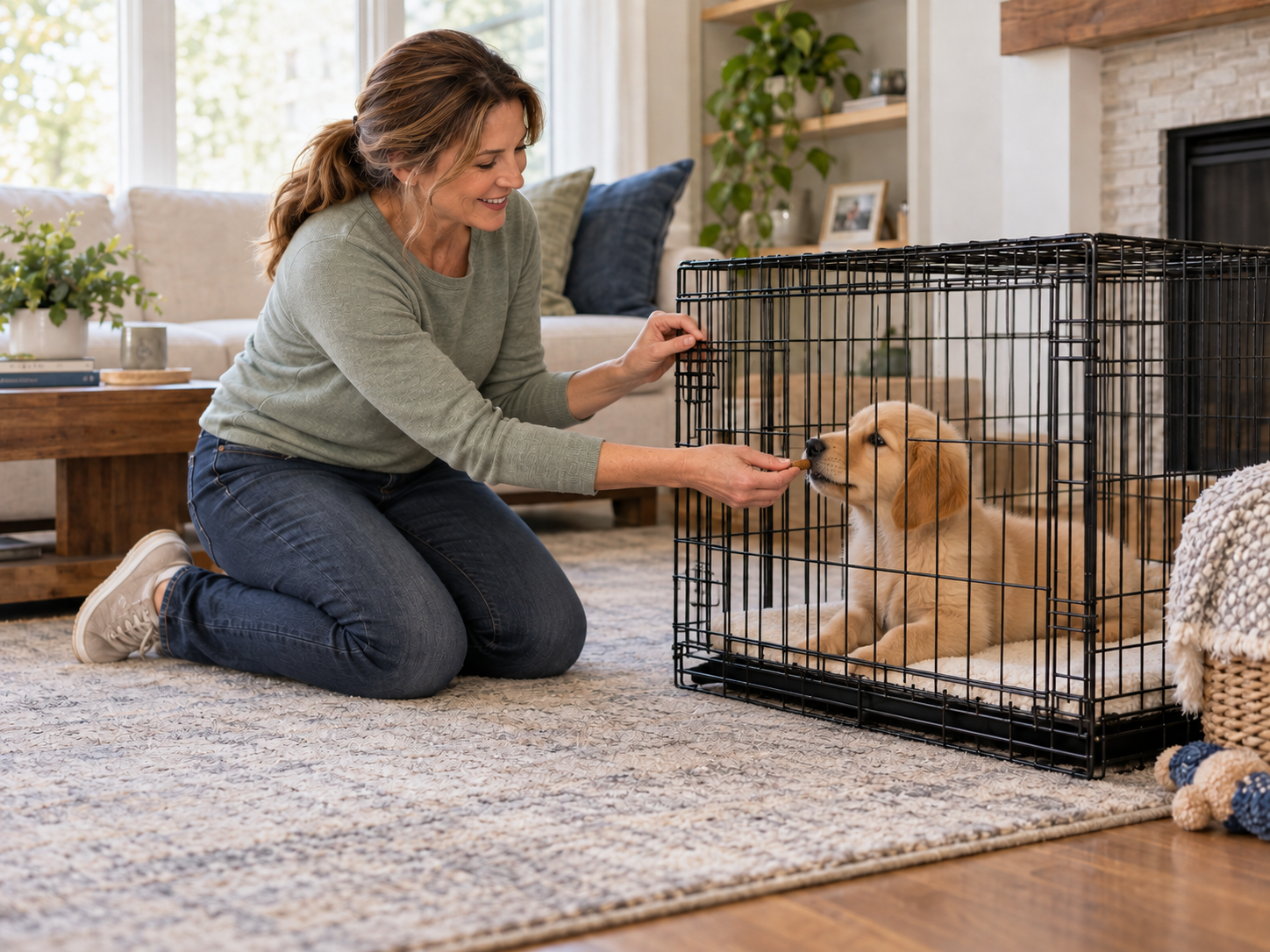
Now give your puppy a chew or food-stuffed toy and close the door for five minutes.
Sit nearby, but do something else.
Drink coffee. Read your phone. Fold laundry. Work at your desk.
You are present, but you are not the activity.
Morning Goal
Your puppy relaxes behind the closed door for five minutes while your attention is somewhere else.
MIDDAY: THE HUMAN MOVES
Begin with two easy minutes of closed-door crate time.
Now start moving:
- Stand up and sit down.
- Walk around the crate.
- Walk across the room.
- Sit in a different chair.
- Touch the doorknob and return.
- Step through the doorway and come back.
Complete 10 to 15 movement repetitions.
Mix them together:
- Walk across the room.
- Sit nearby for 20 seconds.
- Step through the doorway for 5 seconds.
- Walk around the room.
- Sit across the room for 30 seconds.
- Step out for 10 seconds.
- Return and sit down.
Reward your puppy occasionally, but not after every movement. Your walking around should gradually become part of the background.
Midday Goal
Your puppy watches you move around the room and through a doorway while remaining in the crate.
AFTERNOON: THE OUT-AND-BACK GAME
Give your puppy something enjoyable inside the crate.
Begin stepping out of sight:
- 5 seconds
- 10 seconds
- 20 seconds
- 30 seconds
- 1 minute
- 2 minutes
- 3 minutes
- 5 minutes
Mix short absences with longer ones.
Your practice might look like this:
- 10 seconds
- 30 seconds
- 10 seconds
- 1 minute
- 20 seconds
- 2 minutes
- 30 seconds
- 3 minutes
- 1 minute
- 5 minutes
Come and go casually.
Sometimes walk past the crate without stopping. Sometimes deliver a treat. Sometimes sit nearby for a minute before leaving again.
Your puppy is learning the pattern:
You leave. You come back. Nothing unusual happened.
Afternoon Goal
Your puppy continues chewing, resting or watching the room while you disappear for several minutes.
EVENING: THE 10-TO-15-MINUTE CRATE BREAK
Take your puppy outside, include some play or training and give them a chance to wind down.
Then:
- Cue your puppy into the crate.
- Give them a safe chew or food-stuffed toy.
- Close the door.
- Complete a task for 10 minutes.
You might:
- Take a shower
- Fold laundry in another room
- Prepare dinner
- Clean the bathroom
- Sit outside
- Work at your desk
Return calmly. Walk through the room, put something away or sit down before opening the door.
If your puppy was comfortable for 10 minutes, try 15 minutes during the next natural rest period.
Evening Goal
Your puppy spends 10 to 15 minutes in the crate while you are out of sight and doing something else.
THE DAY 2 WIN
Your puppy is no longer practicing only while you sit beside the crate.
They have watched you walk around, move through doorways and disappear for several minutes. They have also completed a 10-to-15-minute crate break while you did something else.
Your puppy is learning that being unable to follow you does not mean they have been forgotten.
DAY 2 COMPLETE
DAY 3: PRACTICE BEING AWAY
Today’s Destination
By tonight, your puppy may be ready to relax in the crate for 20 to 30 minutes while you shower, work elsewhere, spend time outside or briefly leave home.
Today still includes familiar repetitions. The difference is that the practice now begins looking like an ordinary part of your day.
MORNING: REBUILD THE RHYTHM
Start Day 3 with skills your puppy already knows:
- Five happy crate entries
- One minute with you nearby
- One minute with you moving around
- One 30-second absence
- One two-minute absence
- One easy 30-second absence
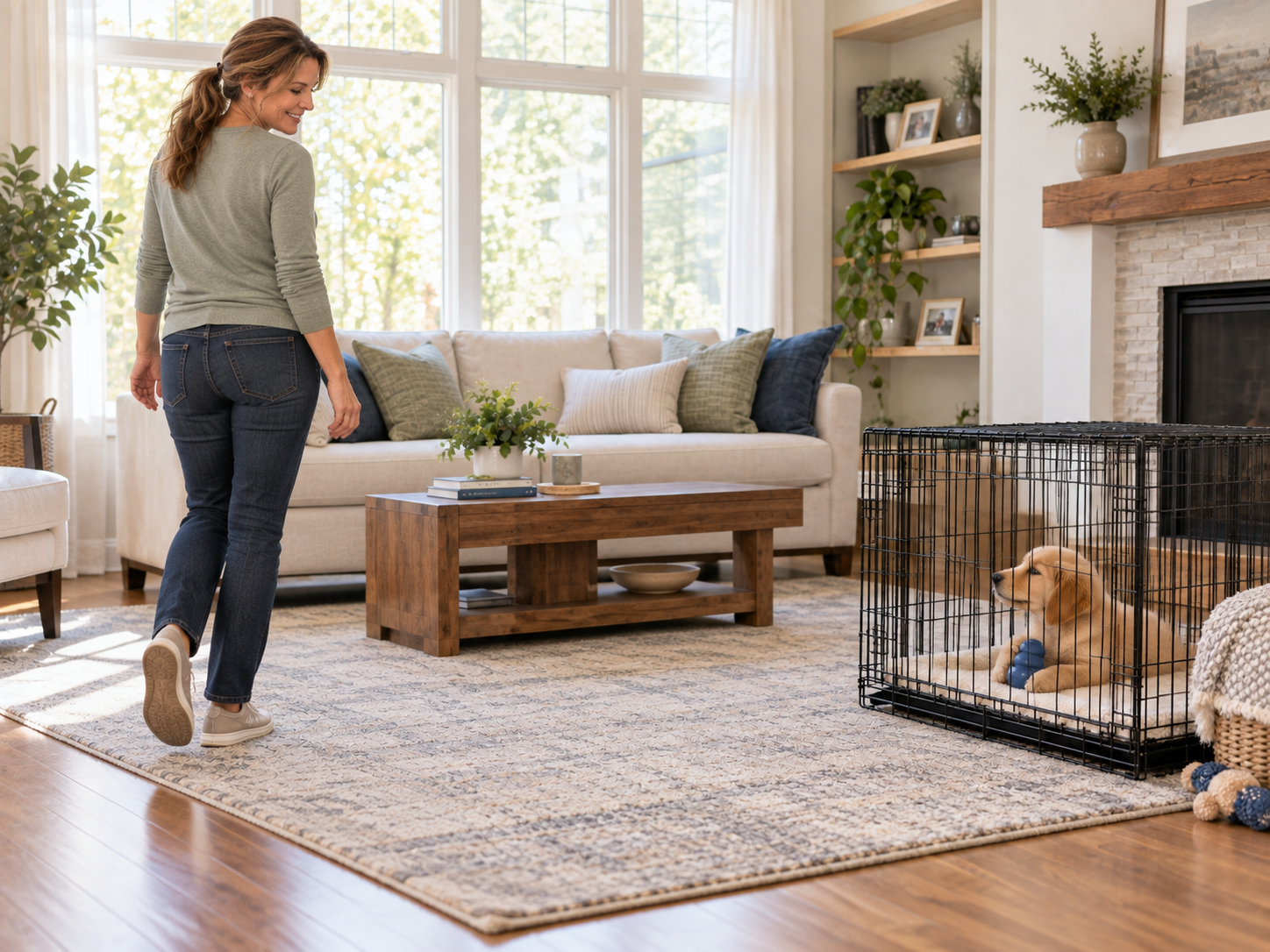
Next, complete a five-minute task in another room.
Return, spend a minute nearby and then step away again for another two or three minutes.
Repeat the pattern several times:
- Easy absence
- Longer absence
- Easy absence
- Time together
- Another longer absence
Morning Goal
Your puppy quickly returns to the rhythm from Day 2 and settles through several short absences.
MIDDAY: SHOES, KEYS AND THE FRONT DOOR
Now add the little things that happen when people leave home:
- Put on your shoes.
- Pick up your keys.
- Open and close the front door.
- Step outside for 10 seconds.
- Step outside for 30 seconds.
- Walk to the mailbox.
- Stand outside for two minutes.
- Sit in the car for five minutes.
Mix these with easy repetitions.
Pick up your keys and stay home. Put on your shoes and make lunch. Open the front door, close it and sit down.
These actions should become ordinary household sounds instead of a dramatic announcement that you are leaving.
Complete several short exits.
Keep departures simple. Keep returns simple. You left, and now you are back.
Midday Goal
Your puppy remains settled while you use the front door and spend several minutes outside.
AFTERNOON: THE 10-TO-15-MINUTE ABSENCE
Set up the session after:
- A potty break
- Some play, sniffing or training
- A few minutes to wind down
Cue your puppy into the crate and provide a safe activity.
Leave the house or remain completely out of sight for 10 minutes.
If you have a camera or spare phone available, use it to see whether your puppy continues chewing, looks around or settles down.
Return and spend time at home before the next crate session.
If 10 minutes went smoothly, try 15 minutes during the next practice.
Afternoon Goal
Your puppy spends 10 to 15 minutes without seeing or hearing you nearby.
EVENING: THE 20-TO-30-MINUTE ABSENCE
This is the session the entire plan has been building toward.
Set your puppy up:
- Take them outside to potty.
- Include some play, sniffing or training.
- Give them a few minutes to wind down.
- Cue them into the crate.
- Provide a safe chew or food-stuffed toy.
- Leave calmly.
Aim for 20 minutes.
If your puppy is still settled at 20 minutes, continue to 30.
Use the time for something you need or want to do:
- Take a shower and get dressed
- Make dinner
- Work in another part of the house
- Sit outside with a cup of coffee
- Walk around the block
- Run one short errand
When you return, put away your keys or belongings and then let your puppy out calmly.
Take them outside and continue with your day.
Evening Goal
Your puppy relaxes in the crate for 20 to 30 minutes while you are away.
THE DAY 3 WIN
Over three days, your puppy practiced:
- Dozens of happy crate entries
- Eating and relaxing inside
- Waiting for a release word
- Staying behind a closed door
- Watching you move around the house
- Seeing you leave and come back
- Hearing shoes, keys and the front door
- Spending 20 to 30 minutes independently
Three days ago, the crate was new.
Now it is becoming a useful part of your routine.
DAY 3 COMPLETE
YOU ARE ALREADY CRATE TRAINING
These three days were not preparation for crate training.
They were crate training.
You introduced the crate, built a cue, added the door, practiced duration, added distance and completed an absence.
Keep using the same pattern:
- Begin with an easy win.
- Repeat what is working.
- Add one challenge.
- Return to something familiar.
Use the crate throughout your day.
Tomorrow, repeat a comfortable 20-to-30-minute session.
From there, begin adding five or ten minutes at a time. Continue mixing longer sessions with easy, shorter ones.
Your next milestones may be:
- A 30-minute morning routine
- A 45-minute work session
- A one-hour trip away from home
- A puppy nap
- A crate break while visitors are over
You and your puppy are no longer standing at the starting line.
You are already doing it.
THE CRATE-TRAINING LADDER
Use this ladder whenever you need to decide what comes next:
- 1Enter when you say “Crate”
- 2Wait for the release word
- 3Relax with the door closed
- 4Watch you move around the room
- 5Stay settled when you step out of sight
- 6Handle a five-minute absence
- 7Handle a 10-to-15-minute absence
- 8Handle a 20-to-30-minute absence
- 9Add five or ten minutes
- 10Practice at different times of day
THE LEVEL-UP RULE
CHANGE ONE CHALLENGE AT A TIME.
If you add more time, keep the distance familiar.
If you move farther away, make the absence shorter.
If you practice during a new part of the day, begin with an easier amount of time.
Repeat each level until it feels ordinary. Then move up.
WHEN YOUR PUPPY HAS SOMETHING TO SAY
Some puppies settle quietly. Others make their opinions known.
The sound alone does not tell you what your puppy needs. Look at when the crying started, what your puppy is doing and what happened immediately beforehand.
“I MIGHT NEED TO GO OUTSIDE”
Your puppy may need a potty break if:
- They just woke up
- They recently ate, drank or played
- They were sleeping and suddenly began crying
- They are circling or unable to settle
Take them outside for a quiet potty trip. Give them a chance to go, then return to the crate.
Keep nighttime and training potty trips brief so they do not accidentally become playtime.
“I WOULD RATHER BE OUT THERE”
Your puppy may be complaining if:
- The noise begins when the fun ends
- They pause and listen for your response
- Their body remains loose
- They can still eat or focus on a chew
Give them a moment to settle.
When possible, open the door during a quiet pause so calm behavior becomes part of the routine.
Make the next repetition easy, give your puppy another win and continue practicing.
“THIS STEP IS TOO HARD RIGHT NOW”
Your puppy may need an easier repetition if:
- Their behavior keeps becoming more intense
- They stop taking food
- They are panting or drooling heavily
- They are biting the crate or desperately trying to escape
Help your puppy out safely and return to the last level they handled comfortably.
A difficult round does not erase the earlier wins. It shows you which part needs more repetition.
Listen to the noise, but watch the whole puppy.
MAKE NIGHTTIME EASIER
A young puppy has just left their mother, littermates and everything familiar. Placing the crate near your bed can help them adjust while making nighttime potty trips easier for you.
When your puppy wakes:
- Take them outside.
- Give them a chance to potty.
- Return to the crate.
- Turn the excitement back off.
During the day, continue using the three-day plan to build independence.
As your puppy becomes more comfortable, gradually move the crate toward its permanent location if you want it somewhere else.
Sleeping near your puppy at first does not cancel the daytime training. Nighttime and daytime are different parts of the routine.
WHERE DO YOU NEED ANOTHER REPETITION?
THE CRATE GIVES BOTH OF YOU MORE FREEDOM
Crate training is not only about where your puppy sleeps.
It gives your puppy a safe place to relax while you:
- Take a shower
- Cook dinner
- Work
- Answer the door
- Clean the house
- Give another pet a break
- Enjoy twenty uninterrupted minutes without someone biting your ankles
It also prepares your puppy for travel, boarding, grooming, veterinary care and other situations where resting comfortably in a contained space will help.
Your puppy is learning that they can relax without being entertained every minute.
That is an important life skill.
And yes, you can go take your shower.
SAVE THIS FOR TOMORROW
Crate training becomes reliable through repetition.
Save this guide and return whenever you are ready to:
- Repeat a favorite game
- Add another five minutes
- Take a few more steps away
- Practice during a different part of the day
- Rebuild the routine after a difficult session
You now have a plan, a progression ladder and a clear way to decide what comes next.
WHEN YOUR PUPPY REWRITES THE PLAN
Plans are helpful. Puppies still find ways to surprise us.
Claire is Raising My Puppy’s expert puppy helper. Tell her your puppy’s age, which crate-training level you are practicing and what happens when you step away.
She can help you decide what to repeat, what to change and which step to try next.
Raising My Puppy provides general puppy training and care information, not veterinary, behavioral or medical diagnosis or treatment. Contact your veterinarian or a qualified behavior professional if you have concerns about your puppy’s health, safety or behavior.
All guides · Planners · Home · Pricing